“It was raining”
Elena KnowsThe recurring expression It was raining is the small, concrete fact on which Elena’s challenge to the accepted account of Rita’s death depends. Rain links an unusual death at the church belfry to a habit Elena believes she knows intimately: Rita avoided the church whenever stormy weather threatened. The expression therefore carries two kinds of force at once. It records the conditions of the day, and it marks the gap between what officials conclude and what Elena believes her knowledge of her daughter makes impossible.
A detail with a history
For Elena, the rain matters because Rita’s avoidance of the church was not an idea formed after her death. As a child, Rita learned that the cross above the church attracted lightning, a danger her father explained to her. She was afraid of lightning and took the lesson seriously. When rain was forecast, she also avoided the Inchauspes’ house, then the neighbourhood’s only home with a swimming pool. Rita had heard about the danger of swimming during a storm, and additional pools or lightning rods would only have created further possible detours.
These precautions formed part of a larger pattern of habits through which Rita tried to limit danger. She avoided the checkerboard tiles outside the midwife’s office, devised a rhyme and a gesture for encounters with redheads, and touched her hand to her chest when someone mentioned Liberti, a man regarded in the neighbourhood as unlucky. The habits could complicate ordinary movement, but their very recurrence made the rain-day prohibition meaningful to Elena: it was not an isolated preference that might casually disappear.
Rita continued to avoid the church in bad weather after she began working at the Catholic school at seventeen. When asked to go to the chapel in inclement conditions, she made excuses, including feigning illness. That history gives Elena’s recollection a practical basis. Her argument rests not simply on a mother’s assertion that she understands her child, but on a repeated pattern of avoidance extending from Rita’s childhood into her working life.
Rain against the official account
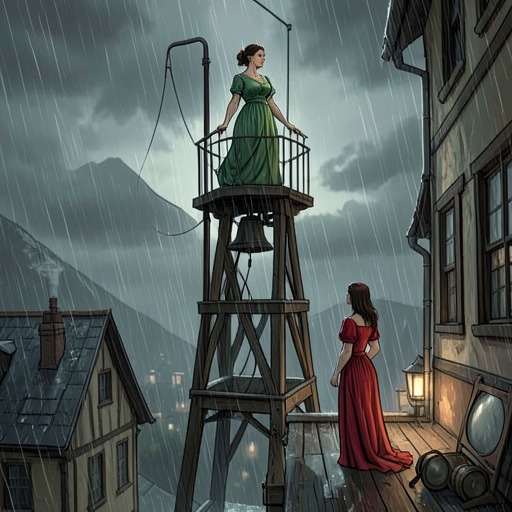
Rita was found dead, hanging from the church belfry on a rainy afternoon. People around Elena, including the coroner, Inspector Benito Avellaneda, and Roberto Almada, accepted suicide as the explanation. Elena could not name a killer or identify a motive, and she knew she could not prove murder by herself. Still, the weather contradicted the behaviour she associated with Rita. If Rita had gone to the church on a rainy day, Elena reasoned, someone must have brought her there, whether alive or dead.
The narrative emphasizes how little this detail changes other people’s conclusions. Father Juan and the police do not interrupt the seven o’clock mass after the body is discovered; parishioners attend without knowing what is above them. No bells announce the service, and rain falling in the courtyard is the sound Elena later distinguishes in the church’s silence. Her attention to that sound separates her from the congregation’s ignorance and anticipates the importance she will attach to the weather.
The contrast is not between a fully solved case and an obviously false verdict. Elena has no identified perpetrator, and the people assigned to the case do not accept her inference. The rain instead keeps open a conflict between circumstantial knowledge and proof: it supports Elena’s suspicion without supplying the evidence needed to establish it.
From recollection to an appeal for help
When Elena visits Isabel, she explains that the rain is why she rejects the suicide account. Isabel asks how Elena can know, but does not immediately share the force of the reasoning. The conversation shows that the expression does not function as a persuasive fact on its own. Its meaning depends on knowing Rita’s habits, and on accepting Elena’s claim that years of observing her daughter give her knowledge others lack.
Elena also recounts that she made a list of suspects for Inspector Benito Avellaneda and followed possible leads. The people on the list, she was told, had been elsewhere on the day Rita died. If the person responsible was not among them, Elena reasons, the possibilities widen to include someone she does not know. Investigation would require travel, questions, clues, motives, dates, and evidence—work she recognizes she cannot manage with her own body and Parkinson’s disease.
The rain thus becomes the beginning of a practical request, not merely the emblem of Elena’s grief. She seeks out Isabel, whom she has not seen for twenty years, because Isabel has a body that can move, look, and ask questions on her behalf. Elena describes this help in terms of a debt Isabel feels she needs to repay. The inference supplied by the rainy day leads directly to the need for another person’s participation: Elena believes the detail, but cannot pursue its consequences alone.
The expression’s limits and force
The recurring expression holds together certainty and uncertainty. Elena is certain that Rita’s conduct and the weather do not fit the accepted explanation; she is not certain who killed her daughter or why. Her knowledge of the rain is precise, but it cannot identify a perpetrator. In this way, the detail resists both dismissal as mere atmosphere and elevation into conclusive proof.
Its force also tests Elena’s claim to maternal knowledge. She believes that being Rita’s mother allows her to understand what Rita would and would not have done, even though the two had fought, kept their distance, and rarely expressed affection. The rain lends that claim a specific foundation, while leaving its limits visible: a familiar habit can sharpen suspicion, but it cannot by itself settle the facts of a death.
Across the discovery, the silent mass, Elena’s journey, and her explanation to Isabel, rain recurs as a measure of attention. Others accept the official account or fail to notice the courtyard’s sound; Elena holds on to the weather because it preserves a contradiction they have set aside. The expression names the fact that keeps her investigation moving, even as the truth it points toward remains unproved.